Stridefor

Healthcare GTM needs more than generic firmographics

Stride helps healthcare teams size and prioritise accounts using lifecycle stage, R&D intensity, regulatory footprint, hiring focus, and entity structure.

Lifecycle Signals

In healthcare, lifecycle and regulatory complexity change account value

A pre-commercial biotech, a scaling medtech business, and a mature healthcare operator can look similar in broad firmographics while behaving very differently commercially.

  • A pre-commercial company should not be treated like a mature commercial operator.
  • R&D spend often tells you more about strategic focus than top-line revenue.
  • Regulatory footprint changes how complex expansion, compliance, and buying processes are likely to be.
  • Hiring focus shows whether a company is investing in science, regulatory, manufacturing, or commercial growth.
Healthcare organisation chart illustrating how healthcare company structure extends beyond generic firmographics.
Sector Signals

Add the healthcare signals that actually change prioritisation

Footprint helps healthcare teams work from a more useful company layer by modelling signals like R&D spend, lifecycle stage, regulatory footprint, hiring focus, and vendor dependency. That gives strategy, GTM, and planning teams a more realistic view of how each company operates.
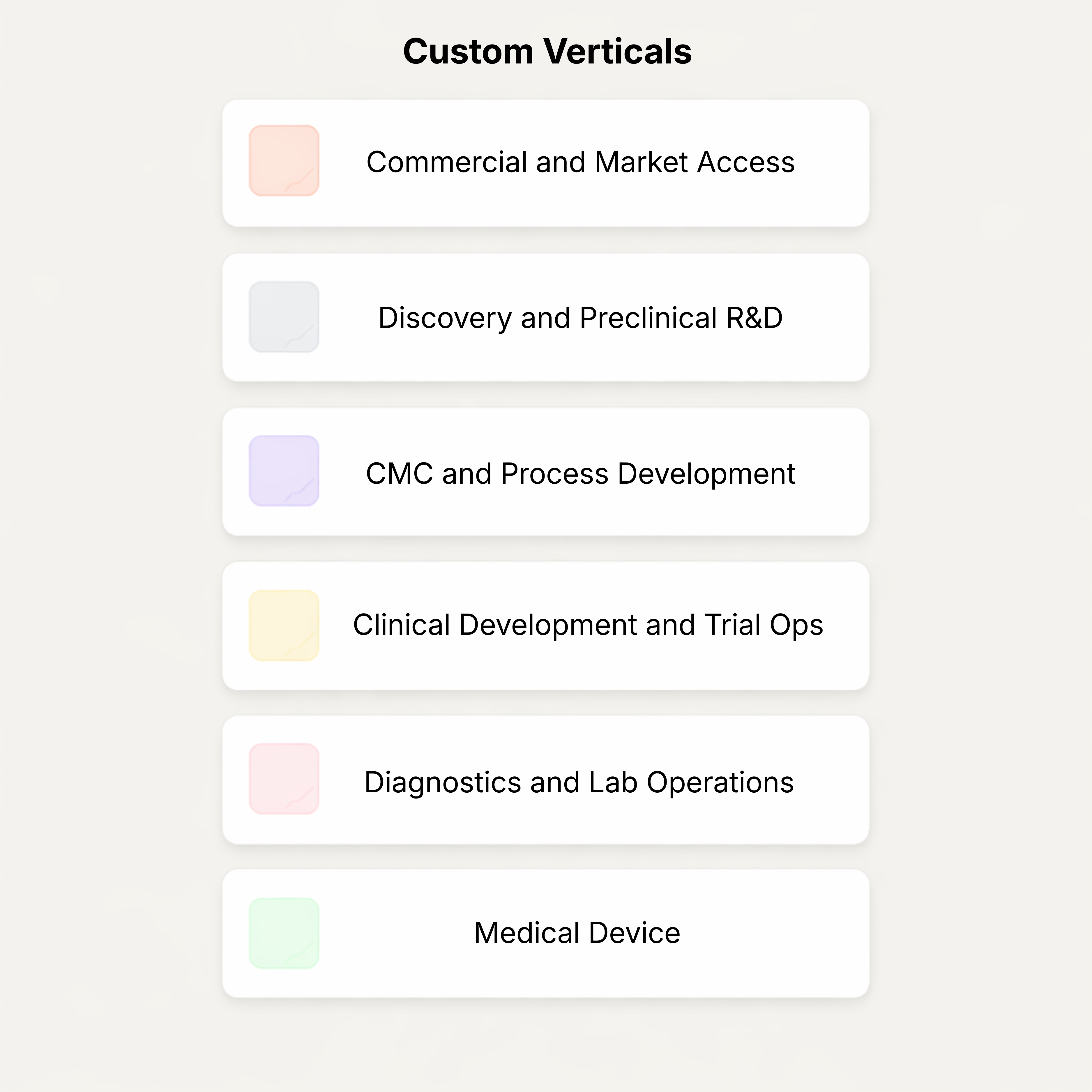
  • Classify lifecycle stage from R&D only through to scaling or mature commercial.
  • Estimate R&D intensity to distinguish science led businesses from commercial stage operators.
  • Map regulatory footprint across single and multi-jurisdiction businesses.
  • Track whether hiring is concentrated in R&D, clinical, regulatory, manufacturing, or commercial functions.
Healthcare verticals graphic showing the sector-specific signals used for healthcare prioritisation and planning.
Better Prioritisation

Size and segment healthcare accounts with vertical specific logic

Opportunity Sizing applies healthcare aware logic so accounts are prioritised based on how they actually progress, scale, and buy. This produces more commercially relevant segmentation than forcing every healthcare business into the same generic scoring model.

  • Differentiate early stage, validation stage, and mature commercial companies more cleanly.
  • Use R&D spend and hiring mix as signals of organisational focus and momentum.
  • Factor regulatory complexity into territory and market prioritisation.
  • Tailor account scoring around how healthcare companies actually evolve over time.
Healthcare segmentation graphic showing vertical-specific account sizing and prioritisation logic.
Commercial Context

Turn healthcare complexity into clearer GTM decisions

Stride compares your CRM to a more differentiated healthcare company universe, then recommends the signals and fixes most likely to improve segmentation, targeting, and planning. The result is not just cleaner data, but better commercial judgement.

  • Enrich the accounts where lifecycle stage or regulatory complexity changes how they should be worked.
  • Add signals like vendor dependency to reflect operating model and outsourcing intensity.
  • Improve whitespace and coverage decisions with a more realistic healthcare market map.
  • Deploy changes with sourcing, confidence scoring, approvals, and rollout controls.
Healthcare GTM process graphic showing clearer GTM decisions built on healthcare-specific company context.

Lorem ipsum dolor sit amet?

Lorem ipsum dolor sit amet, consectetur adipiscing elit, sed do eiusmod tempor incididunt ut labore et dolore magna aliqua. Ut enim ad minim veniam quis nostrud exercitation ullamco laboris.